For a long time, I tracked my finances with spreadsheets.
There was nothing particularly wrong with that.
Spreadsheets are flexible. They are familiar. They let you start without designing a system first.
But over time, flexibility can become fragmentation.
I ended up with several files, each useful for a different purpose. Some helped me understand my overall position. Others were useful when preparing information for my accountant. A few existed because, at some point, I needed to answer a specific question and creating another spreadsheet was the fastest way to do it.
The system worked.
It just required more attention than I wanted to give it.
The recurring work behind a simple question
The question I wanted to answer was not complicated:
What does my financial position look like today?
Getting to the answer was more tedious than it should have been.
Information lived in different places. Some accounts needed to be reviewed separately. Documents had to be gathered again at the end of the year. Spending time abroad added another layer of administrative complexity, especially during a period when my tax situation crossed more than one jurisdiction.
None of these details was dramatic on its own.
Together, they created a recurring task that was easy to postpone and annoying to repeat.
Building for a user I understood
Fidelis Wealth began as a tool for one person: me.
That was part of what made it fun to build.
I did not need to imagine every possible use case. I could start with the questions I actually had:
- Can I see my assets and liabilities in one place?
- Can I understand how the picture changes over time?
- Can I keep the information organized without maintaining several files?
- Can I make the annual reporting process less repetitive?
- Can I use the application comfortably from a phone or a laptop?
The first version did not need to solve personal finance in general.
It needed to improve a workflow I already knew well.
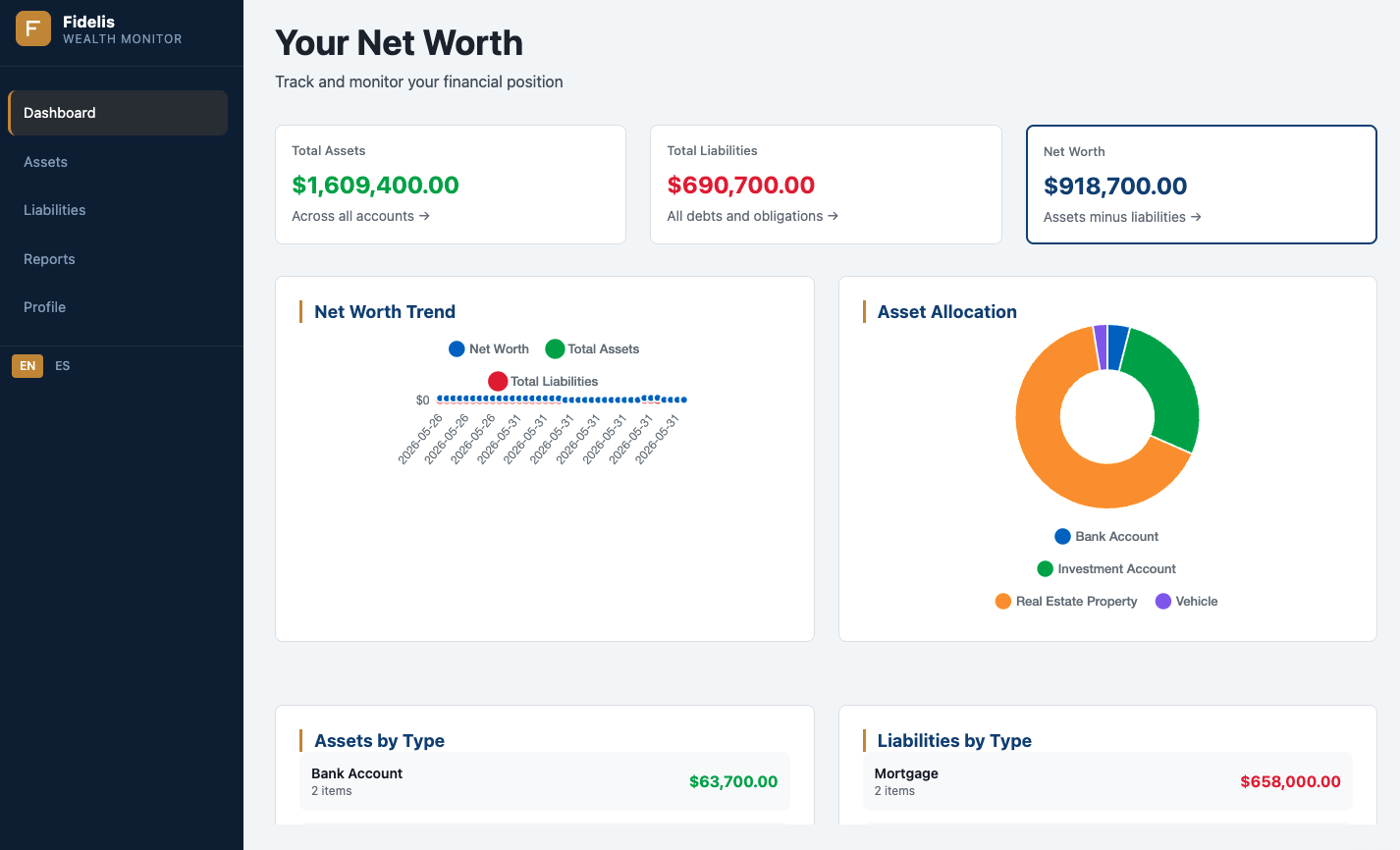
Screenshot captured with fictional demo data.
What changed when I started using it
The most useful improvement was not a chart or a specific technology.
It was having a single place to update information.
Once the data was organized consistently, other things became possible:
- A clearer view of net worth
- A history of changes over time
- Reports prepared from structured data
- Less searching for the latest version of a spreadsheet
- A simpler handoff when information needs to be shared with an accountant
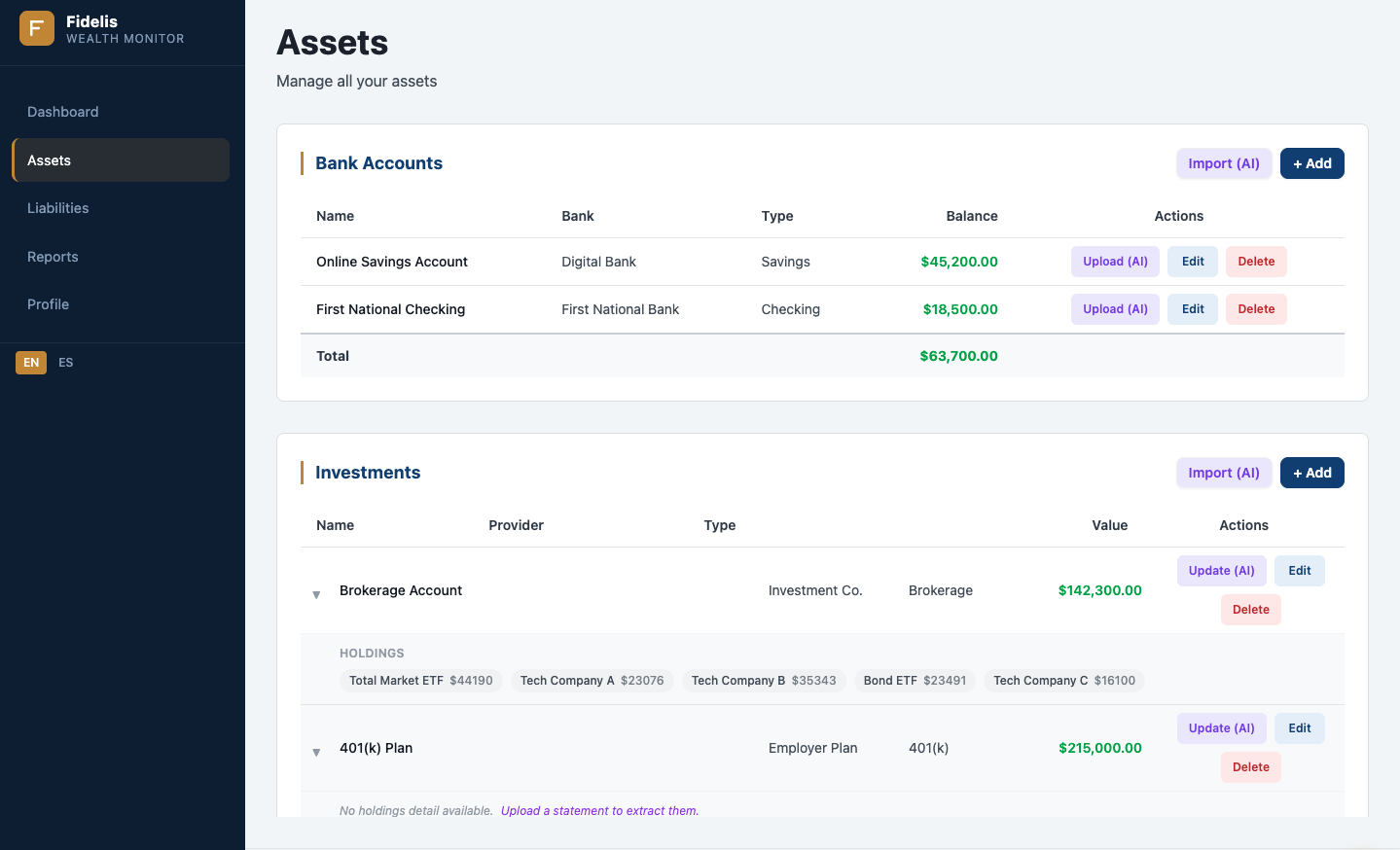
Screenshot captured with fictional demo data.
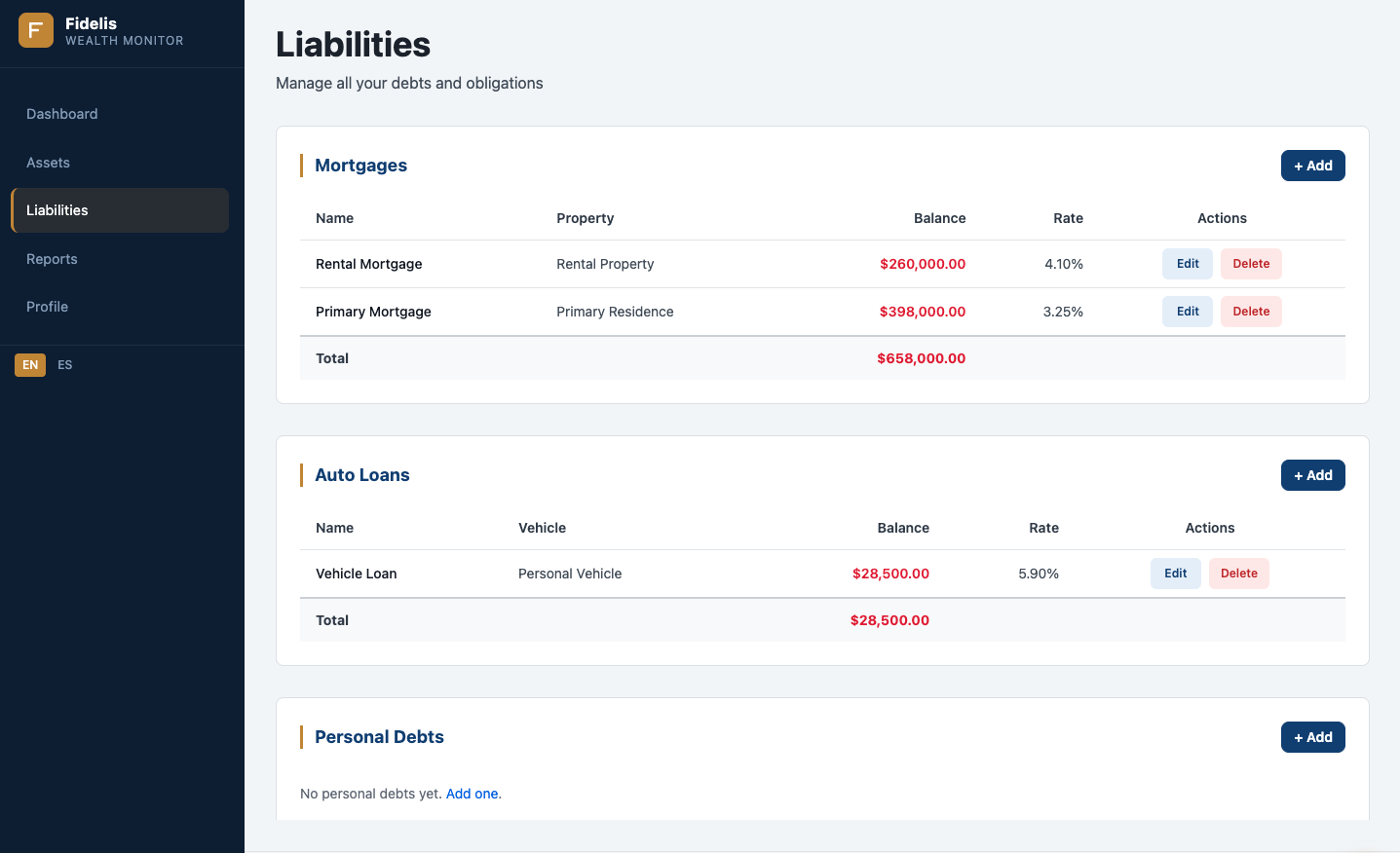
Screenshot captured with fictional demo data.
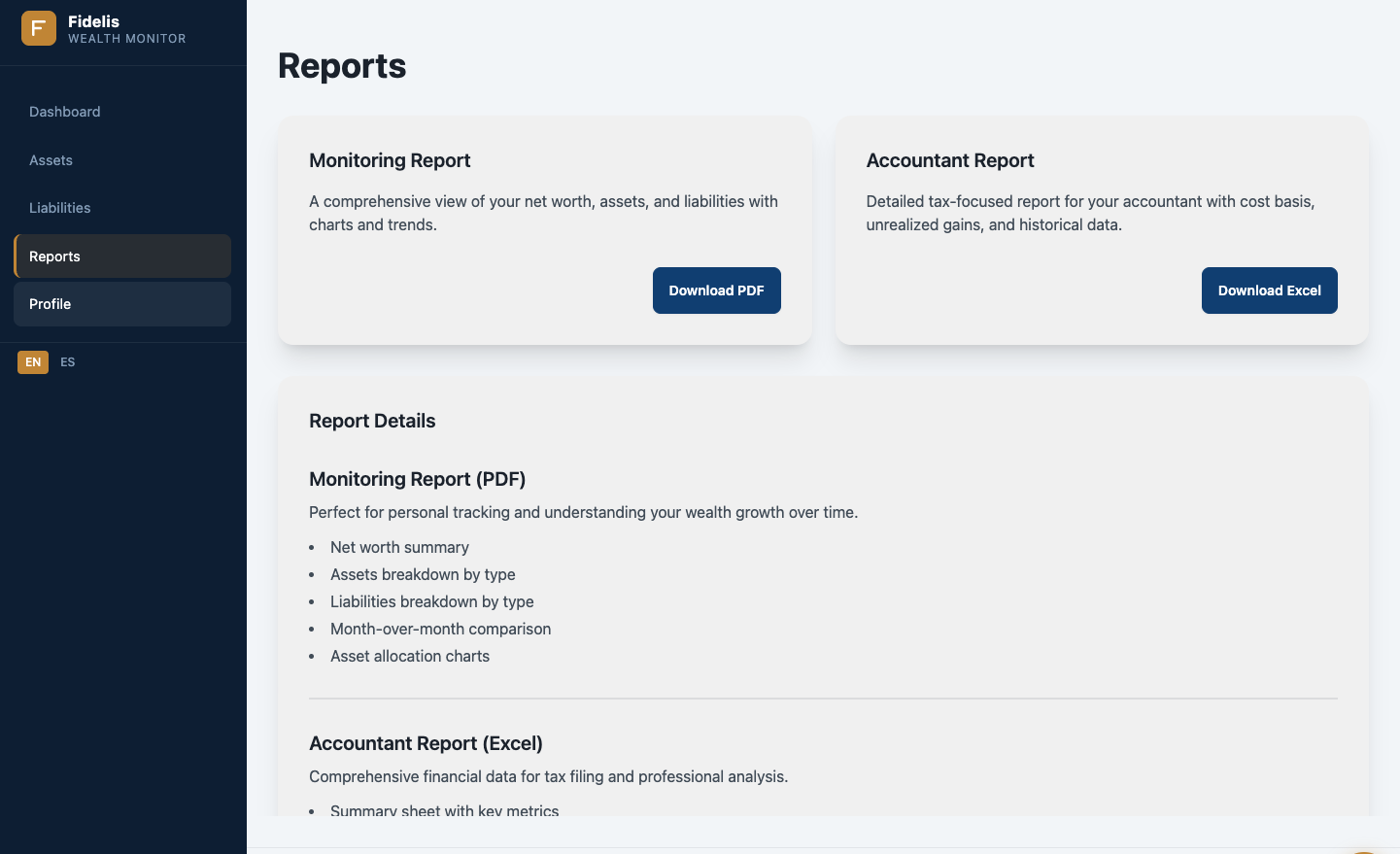
The product started to feel useful before it felt complete.
That distinction matters. Software does not need a long feature list to remove friction from a real task.
Reducing repetitive work
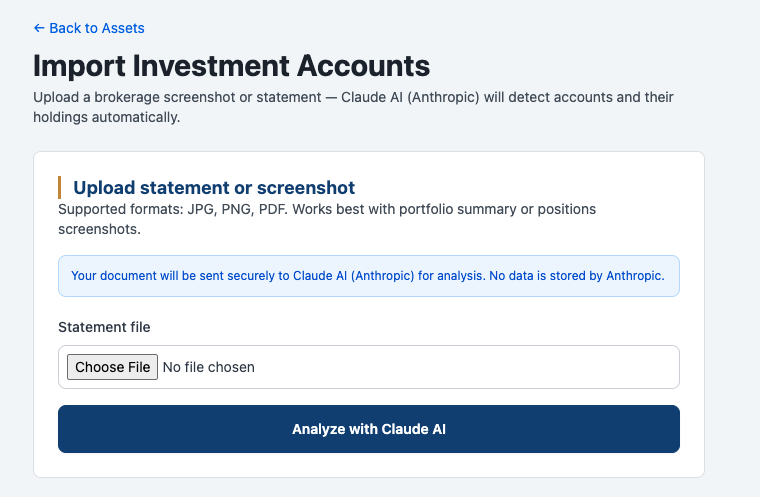
One of the experiments was a document-import flow for investment statements.
Instead of entering every value manually, the application can analyze a statement and prepare information for review. The review step is important: financial data should not be silently accepted just because an automated process extracted it.
A personal workflow is not a market
Building something for yourself is a useful starting point, but it has limits.
My own habits are not proof that everyone has the same problem. Other people may prefer spreadsheets. They may have simpler financial lives. They may need features I have not considered.
Still, I suspect the underlying friction is not unique.
Many people accumulate financial information gradually. They add accounts, documents, investments, or obligations over time. The complexity does not arrive all at once. It grows quietly until a simple question requires opening several files and checking several sources.
That is the part of the problem I want to explore further.
Privacy is part of the product
Personal finance software handles information that deserves care.
That affects both the product and the way I write about it.
I can document the workflow, the decisions, and the lessons without publishing private details. The interesting story is not what someone owns or where their accounts are located. It is the design challenge of making fragmented information easier to manage.
This also shapes future work. Convenience matters, but it has to be balanced with trust, data protection, and a clear understanding of what should remain under the user's control.
What I learned
The main lesson was not technical.
Building for myself gave me a direct feedback loop. When an update felt tedious, I noticed. When a report was not useful, I had to improve it. When a screen made sense on desktop but not on mobile, I encountered that problem in ordinary use.
There was no distance between the builder and the first user.
That does not guarantee that Fidelis Wealth will work for other people.
But it is a reasonable place to begin.
Closing reflection
Some projects start with a market analysis.
This one started with a folder of spreadsheets and a task I was tired of repeating.
I built Fidelis Wealth because I wanted a better way to organize my own financial information. It has already made that workflow simpler for me.
The next question is whether the same approach can help other people who have accumulated a similar kind of complexity.
That is worth exploring.
Explore Fidelis Wealth.
- Diego Cervera