
Over the years I have worked with many software systems that were technically healthy but surprisingly difficult to maintain. The source code was available, the documentation existed, and the requirements could still be found somewhere in the organization's tooling. Yet when a significant change was needed, teams often struggled to answer a simple question: why was this built this way?
The challenge was rarely a lack of information. In most cases there was an abundance of information scattered across user stories, architecture documents, pull requests, meeting notes, chat conversations, and support tickets. The problem was that the reasoning behind important decisions had become disconnected from the artifacts that survived.
The Cost of Lost Context
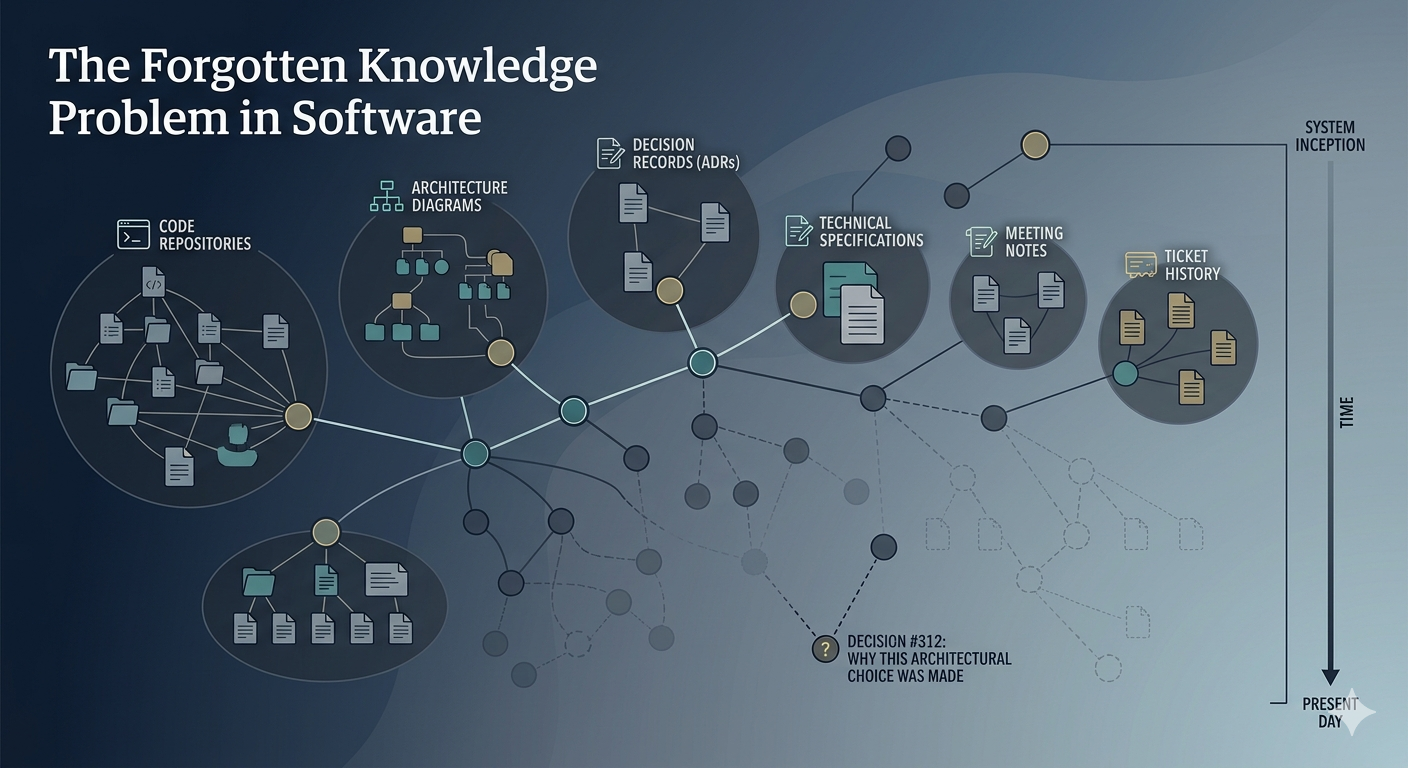
As systems mature, organizations accumulate knowledge in hundreds of small decisions. Some decisions are architectural, some are functional, and others are operational. Each of them is perfectly reasonable when viewed in the context in which it was made. The difficulty appears years later, when the original context has disappeared. People change roles, projects are reorganized, priorities evolve, and eventually nobody remembers the assumptions that guided those decisions.
This creates a form of debt that is different from technical debt. A system may have clean code and a modern architecture while still suffering from what could be called knowledge debt. The organization becomes increasingly dependent on a handful of individuals who remember how things evolved and why certain tradeoffs were made. When those individuals move on, the knowledge often leaves with them.
Information vs. Understanding
The emergence of AI has made information retrieval significantly easier, but I am not convinced that retrieval is the core problem. Most organizations already possess vast amounts of information. What they lack is a reliable way to preserve context, connect decisions to outcomes, and understand whether knowledge that was valid three years ago is still relevant today.
Perhaps the next generation of software knowledge management will not focus on creating more documentation. Perhaps it will focus on building a living memory of the product itself. A memory that connects requirements, discussions, decisions, implementations, incidents, and operational experience into a traceable history that can be explored when needed.
The Real Problem
I do not know whether this is a product, a platform, or simply a direction worth exploring. What I do know is that every experienced engineer has eventually encountered a system where nobody could confidently explain why something existed. When that happens, the problem is not a lack of code or documentation. The problem is that the organization has lost part of its memory.
I am curious whether others have experienced the same challenge and, more importantly, how they have tried to address it.